Friday, 8 August 2008

Did the Americans give us our Igorot identity?


I was struck by the ideas presented by Gerard Finin in his book The Making of the Igorot: Contours of Cordillera Consciousness while reading it this morning for a paper I need to write. Couldn't help but share it. What do you think of the following paragraphs?

Crucial in the formulation of American plans for bringing "civilization" to the Cordillera and making highlanders a more integral part of the already largely Hispanized lowland Philippines was the view that all of the "natives" were basically "the same." Establishment of a distinctive administrative grid in the Cordillera was not the product of a grand plan for divide and rule designed to put highlanders against lowlanders. Rather, it was based more on prevailing American conceptions about "types" of people and a strong desire for a "rational" system of administration based on "scientifically" justifiable principles for overseeing highlanders.

This thinking drove the American officials who imposed the colonial structure on Luzon's largest highland territory. From the plans and policies that were devised and implemented during the early part of the 1900s emerged the spatial and social dimensions of the shared pan-Cordillera regional consciousness that so strongly influences the Cordillera today (italics mine). Before discussing what American rule bequeathed, however, it is important to consider the conditions preceding the American presence. (pp. 19-20)


From Chapter 5:

In keeping with the long-range plan to unite highlanders and, in time, assimilate Mountain Province into lowland Philippine society, American officials early in the century began introducing features of American-style democracy. The establishment of Mountain Province's local governments was key to this effort. As yet another element of the grid, it changed highlanders' consciousness in terms of the way they thought about themselves and those around them. (p. 108)


These paragraphs basically sum up what the book is all about: how the American colonial government in the early 1900s were able to create a region in the highlands - unlike the Spaniards who miserably failed to penetrate it - which has then led to the emergence of a pan-Igorot consciousness. He then goes on to write (and illustrate with some examples) that due to this American legacy, highlanders have learned to identify with one another, despite their different tribal or ethnic groupings - a rather picture-perfect image of a united Igorotlandia. Hmmm...

Just before coming here, my Bicolano historian friend who read it kidded me saying, 'Hey, you should thank the Americans because they gave you your Igorot identity'. Huh? It's a must-read for those interested in Cordillera studies.

I actually have a signed copy of this book as I was there at UP Baguio when Gerard Finin launched his book. I found him a warm, charming scholar who was sincerely interested in the Cordillera. He stayed in Abra for two years as a young Peace Corps volunteer and he still speaks Ilocano fluently. But now that I am reading his book, I realize that it's almost impossible to look at the world and analyse events without bringing in your socio-cultural background into the picture. But I must say that some of his analyses are patronizing. He may be an academic but then he is first and foremost an American who is looking at us, Igorots, with an American perspective. I guess Bakhtin is right: we always speak from a particular position.

Some questions:

Without the Americans, would our forebears not learn to live with one another and respect each other's rights despite their different tribes/ethnic groups, languages, and culture?

Would we have never learned to govern ourselves and advance as a people, at least politically and socially? (Except for Benguet, economically, our leaders still have a lot of work to do to bring us out of the country's list of 20 poorest provinces)

Sadly, we would never find out the answers to these questions because the Americans came into the picture and that's that. We cannot undo what actually happened. But we can create a clearer picture by bringing in more voices into the narrative of the making of Igorot consciousness. How I wish we could find out more how early Igorots saw the world during their time. Maybe we could start asking our own parents' stories who may be in their 70s, 80s, or even 90s. It's never too late to write the stories of ordinary, average, working class Igorots. I am certain their narratives are rich and meaningful despite their lack of education, money or power.

Links: Blast from the Past

Ateneo de Manila University Press

Sunday, 27 April 2008

UK-style U-kay

UK? United Kingdom. At U-kay:-)

Car boot sale ang tawag nila sa ukayan dito. Apart from the usual charity shops where you can buy used items, one of the more popular destinations for bargain hunters are car boot sales, the 'British form of market' where people sell both used and new items from the 'boot' ('trunk' in the US) of their cars.

Yesterday, with the perfect weather (16 C) on our side, my flatmate and I went to Grangetown where the biggest carboot sale in Cardiff takes place. You can find all sorts of interesting items, from this cute personal 'Playboy' water dispenser


to this assortment of saws


yes, even antique radios and a camera!


And one seemingly happy bargain-hunter checking a piece of linen.


The place was packed with people at 11 in the morning it was so much like our very own tiangges. British couples with their babies in carriers, Indians and Pakistanis, Africans, Malaysians - you can find all sorts of people haggling, turning over items, or just eyeing some interesting item.

Although tired from all the walking, I went home happily with my £20 used bike purchase.

Comfort Food

If you've been eating one type of food for almost all your life, you're certainly bound to crave for it when you go to another country. More than missing speaking Tagalog, Ilocano and Kankana-ey, it's really our foooood that I miss most. I guess because food engages all your senses: sight, taste, smell, touch, and yes, even hearing. And all these senses somewhat evoke memories of cold, rainy days (arroz caldo!), late evening with friends (sisig), hot summer picnics with the family (grilled pork chops), six-hour bus trips to Manila (a pack of hot sweet corn), etc.

And so you go on a mission to find Filipino food where you live. Thank God for Chinese and Asian stores because they do sell a number of Pinoy brands. Some items I recently bought:


Bagoong! This particular brand lacks the sweet-salty taste I'm used to but I guess some manufacturers have to suit not just Asian palettes but British consumers as well. The Brits prefer a low-salt, low-fat diet.


Mestizo na itlog na maalat :-) Despite its Chinese brand, these salted eggs are 'made in the UK'. Unlike our 'red eggs' which have been previously boiled before they are sold in the market, these mestizos are sold raw so that you have to boil them first before you can eat them.


And the most important of all, RICE! Amazingly, Thai products such as jasmine rice and chili sauce are available in the grocery stores. You don't even have to go to an Indian or Chinese shop to buy rice here in the UK. It so frustrating that the Thais, who used to come to the Philippines and study at the International Rice Research Institute (IRRI), are now one of the leading rice exporters in the world with Vietnam while poor Philippines is experiencing rice shortage. And the saddest thing of all is that this rice shortage is actually due to corruption and bad governance, as with almost all the ills that plague the country. Billions and billions more are being pocketed by a few at the expense of taxpayers. And we are Asia's only Christian nation? Tsk tsk tsk. Now that isn't a comforting thought.

Monday, 11 February 2008

Gates, Passageways, Doors

What would the world be without doors? What if we just had holes as entrances to homes, buildings or rooms? Hmm, parang exciting isipin.


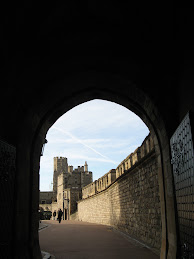
The ancient-looking, simple wooden gate (with a small door) of Eton College at Windsor. Just by looking at this door, you wouldn't think that this is the same door that Princes Harry and William passed through as students at Eton. As far as we know, the wooden gate is off-limits to visitors of Eton. Two Pinoy postgrads and I ended up in front of this gate during a day tour at Windsor because the visitors' entrance was already closed. Lesson: Don't judge a school by its door:-)


But hey, the door was open so I ventured inside and here's what I got: a photo of the school's courtyard! Sayang, Sabado kaya walang students hanging around. Lesson: Don't hesitate to enter open doors. You'll never know what you're gonna find!:-)


A 'Book Passage' at Hay-on-Wye, the only book town in the world. Too bad I didn't check it when I went there for a day tour so I have no idea what it's like inside. I felt there were plenty of other bigger and nicer bookshops to visit I decided to skip this one. Lesson: Don't miss the chance to look around and explore interesting-looking passages or walkways. There's more to life than reading books, anyway:-)


French door of a hotel room overlooking Chao Phraya River in Bangkok. I think that the best kind of door is a French door as it serves both as a window and as a door. Depending on your mood, you can either enjoy the view while inside your room, or push that glass door and be out in the sun. Well, a door is what you make of it;-)

Thursday, 20 December 2007

More on Seasonal Affective Disorder (SAD)

My Pinay friend, Joan, got interested as well about Seasonal Affective Disorder (SAD) and she found out that one celebrity known to have suffered from it was Natalie Imbruglia! Salamat, kaayo for the info:-) By the way, SAD, a mood disorder, is also known as winter depression. Read more about it here.

One of the treatments given to 'SAD people' is light therapy using sun lamps. These are a special kind of lamps which are much brighter than the ordinary ones. For ellenmayjoyceasacla and for us (that includes me) who have never seen a sun lamp in our lives, here's how it looks like, thanks to a photo taken from Amazon:


And here's another one with a more contemporary design, courtesy of Wikipedia:

Saturday, 8 December 2007

Perspectives

I'm totally convinced that our socio-cultural background largely determine the way we look at the world. Wow, what a serious statement to make, you might say:-) But here goes an interesting story from my friend Janice.

Janice attended a workshop about coping with the demands of postgrad studies recently. The presenter was a British professor and she started by asking the participants what made them sign-up for the workshop. 'What problems are you having right now?' she asked them. Janice didn't have a problem at all - she just wanted to know some techniques how she could cope better with the demands of postgrad work:-)

Near the end of the workshop, the presenter gave interesting suggestions for each of the participants. 'Hey Janice, you might want to buy a sun lamp if you miss the sunshine from your country,' she told my friend. By the way, Janice is Asian just like me. She thought that the professor may have had the idea that the British gloomy weather must be making her depressed! And then to another female participant, 'Why not take a trip to the Canary Islands?' It's a great place to spend your Christmas break.'


The Stonehenge against a gloomy December sky.


Janice and I were both almost down to our knees laughing when we met after her workshop. 'Why am I going to need a sun lamp?' she asked, her eyes almost filled with tears as she laughed. We found the whole idea of getting a sun lamp to ease depression totally ridiculous! Or so we thought.

Back in my flat, I shared Janice's little story with my young male British flatmate. I was relating this story to him in an amused way but he looked serious the whole time. Hmm, puzzling. And then he said, 'But there are people who do get depressed because of lack of sunlight.' He then said 'X (I'm not sure anymore) percent of the UK population are affected by seasonal affective disorder (SAD).'*** Ohhhh. I was speechless for two seconds. 'Wow, I didn't know that,' I told him rather lamely. Argg. Blame my ignorance. Or my being Filipino? I thought to myself.

The next day, Janice and I had an interesting talk about this whole sun lamp thing. We both agreed that although we come from a region where we have plenty of sunlight, we found it somewhat unthinkable that people could feel depressed with the weather. 'We have at least 26 typhoons a year in the Philippines but I haven't heard of anybody getting depressed because of the flooding and the rains,' I told her. Janice said, 'It's the same thing where I come from. I guess depression is not an Asian thing (maybe except in the more affluent parts of Asia).' Okay, maybe a good number of Pinoys do get depressed but I'm almost certain that bad weather is not the main reason for it:-)

And then we made the same observation of the Brits apologizing constantly about their weather, almost to a fault. Wow, I wonder how they'd feel if they get the chance to live in the Philippines, or worse, Bangladesh. Where I come from, heavy rains and strong winds are almost a daily companion for six months. But I rarely hear people apologize about it to visitors in the city. Maybe because there's little we can do about the weather...

***One in 50 people in the UK are affected by SAD.

Saturday, 10 November 2007

The Breeze Blows West

It has been almost two months since I arrived here in Cardiff, Wales and I would still pause sometimes and ask myself, "What am I doing here?" A small university town (it's the capital city of Wales), Cardiff is so much like Baguio - small, friendly, charming. Except for the more challenging part of getting used to British and Welsh accents, I'm taking in all these rather new experience like an eight-year-old about to fly a kite for the first time. I'm somewhat anxious yet excited, a bit timid but determined.


Cardiff University's main building


Now that I'm here, I guess I won't be able to write much about my main interests, Cordi people and culture. Ironically, it's because of these same interests that I'm here - to research on ethnicity and identity in the media. Amusing, huh?

But I'd certainly try to write about fellow Pinoys who are working and studying here. I've already met some of them and I was deeply touched by their warmth and hospitality. Iba pa rin ang Pinoy:-)

So I guess this blog will take on a different flavor for the coming several months. I hope to chronicle new learnings, fresh perspectives and interesting characters in my new adventure. So little time, so much to learn:-) I fully agree with the following quote:

What is important is to keep learning, to enjoy challenge, and to tolerate ambiguity. In the end there are no certain answers.

Martina Horner, President of Radcliffe College